J. Prommarin, P. Jitsangiam, T. Somsri, M. Renouf, E. Azéma, Macro–micro mechanical behavior of fresh and degraded ballast from triaxial testing and 3D-DEM with clustering-based polyhedral grain reconstruction, Computer and Géotechnics 195, 108080 (2026)
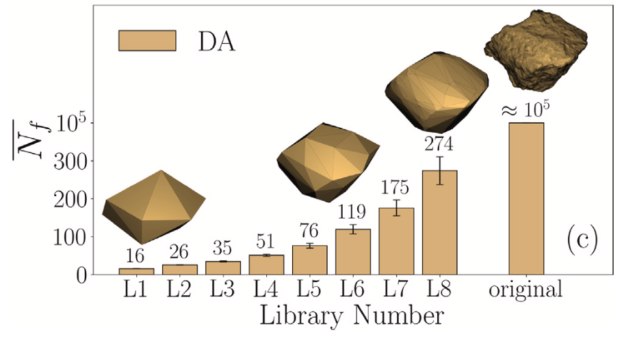
This study investigates the three-dimensional mechanical behavior of fresh and degraded ballast grains from two lithologies (limestone and andesite) by combining advanced laboratory testing and discrete element modeling (DEM). Artificial degradation is induced through multi-million-cycle triaxial loading, after which over 772 grains per lithology and degradation state are digitized using high-resolution 3D point-cloud scanning. A clustering-based reconstruction procedure, inspired by K-means algorithms, is developed to generate polyhedral representations of the grains, characterized by their number of faces and diverse morphological descriptors (i.e., angularity, sphericity…). These digitalized polyhedra are implemented within a Contact Dynamics DEM framework to simulate triaxial compression tests on ballast assemblies. A parametric analysis is performed by varying the number of faces used in the polyhedral reconstruction; macroscopic shear strength responses converge when the number of faces reaches approximately 110–120 faces, indicating that this level of geometric fidelity is sufficient to capture bulk behavior. At the macroscopic scale, all equivalent numerical ballast types exhibit similar residual friction angles of about ≃ 32 − 33◦. In contrast, microscale analysis indicates that fresh andesite develops slightly higher frictional anisotropy than both degraded andesite and fresh limestone. Conversely, fresh limestone and degraded andesite display higher geometric anisotropy than fresh andesite. The balance between frictional and geometric anisotropies explains the similar residual shear strength of fresh and degraded ballast. These results provide a robust framework for linking ballast morphology to performance, with direct implications for the stability and maintenance of ballasted railway tracks.