Archives de catégorie : Articles

Micromechanical signature of representative volume conditions in granular materials: Particle-shape effects and column-like load-bearing structures

J. Prommarin, P. Jitsangiam, M. Renouf, E. Azéma, Computer and Géotechnics 203, 108734 (2026)

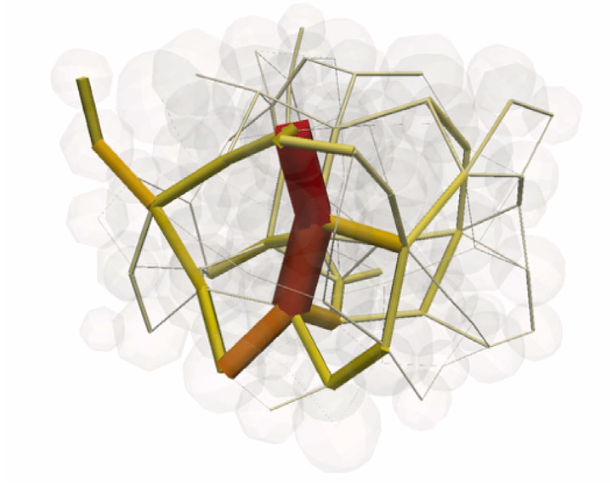
Representative volume conditions in coarse granular materials are investigated using three-dimensional Contact Dynamics simulations of drained triaxial compression tests. Dense assemblies of spherical particles and ballast-like polyhedral grains reconstructed from digitized railway ballast particles are compared to assess how particle shape influences the transition from finite-size-dominated behavior to representative bulk response. The nominal system-size ratio 𝛼= 𝑊0 ∕𝑑max is varied from 3 to 16. The results show that small systems exhibit pronounced stress fluctuations, lower internal coordination, broader normal force distributions, and strong sensitivity of the force-bearing network to specimen size. As 𝛼nom increases, macroscopic quantities and micromechanical descriptors progressively stabilize. For both particle shapes, the macroscopic response becomes only weakly dependent on specimen size for 𝛼 ≥ 8. Particle shape strongly modifies the mechanisms of stress transmission. Polyhedral grains develop higher critical-state shear strength, larger contact anisotropy, and stronger tangential force anisotropy than spheres, reflecting enhanced interlocking and frictional mobilization. However, the apparent transition toward representative behavior occurs over a comparable nominal size range for both particle shapes. A dedicated filtering procedure is introduced to identify column-like structures, defined as unbranched chains of strongly loaded particles. Small systems contain long and frequently percolating structures spanning a large fraction of the specimen height, whereas larger systems exhibit shorter and more spatially distributed load-bearing paths. The progressive loss of systematically percolating column-like structures occurs over the broad size range in which several macroscopic and micromechanical
descriptors become less sensitive to specimen size. These results show that the organization of the force-bearing microstructure provides a complementary physical interpretation of the progressive reduction of finite-size effects.
Experimental evidence of grain size-shape correlation effects on the critical-state shear strength of granular media

Q. Le Van, C. Ovalle, E. Azéma, M. Renouf, J. Barés, S. Buonomo and A. Lizcano. Phys. Rev. E 114, 035426 (2026) – Editors’ Suggestion –

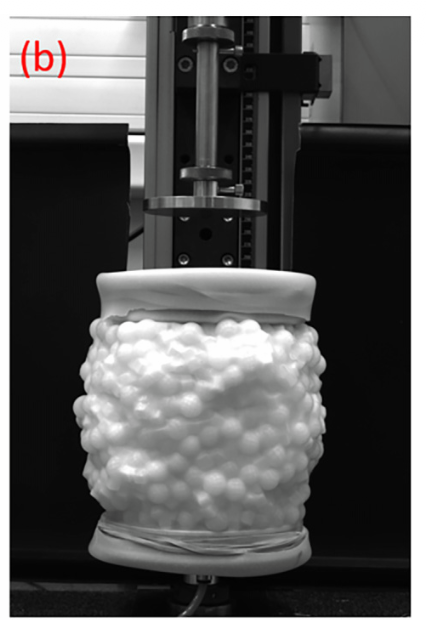
The mechanical behavior of granular media is strongly influenced by particle geometry, including both size and shape. While critical-state shear strength is widely reported to be insensitive to particle size distribution (PSD) in assemblies of grains sharing a common shape, grain shape itself has a strong impact on strength, with angular particles generally producing higher resistance than rounded ones. Many natural and industrial granular materials, however, combine broad size distributions with significant variability in particle shape, often correlated with particle size. Whether the classical PSD-insensitivity of shear strength still holds when particle shape varies across size classes remains largely unexplored. Here, we present a systematic experimental investigation of sheared granular assemblies composed of injection-molded particles with controlled sizes and shapes. Mono, bi, and polyshaped mixtures built from six characteristic grain geometries are tested under triaxial compression. We show that the classical PSD-insensitivity of critical-state shear strength breaks down when particle shape becomes size dependent. For a given PSD, assemblies with angular small grains and rounded large grains exhibit significantly higher shear strength than those with the opposite size–shape arrangement. This behavior persists over a wide range of PSDs and can be explained by enhanced geometrical interlocking promoted by angular small particles filling the voids between larger grains.

A universal scaling framework for granular asteroid strength and its application to the surface of asteroid Bennu

P. Sánchez, E Azéma, K. Jardine, et al. A universal scaling framework for granular asteroid strength and its application to the surface of asteroid Bennu. Nat Commun (2026)
https://doi.org/10.1038/s41467-026-75169-4

Granular asteroids exhibit surprising structural stability despite low gravity and high spin rates. Understanding the mechanisms behind their strength is essential for predicting their evolution and informing deflection strategies. Using 3D particle-dynamics simulations, we develop a scaling framework for the tensile strength of cohesive, self-gravitating regolith, examining how particle size and shape jointly control macroscopic behavior. We show that tensile strength can be scaled using either an equivalent particle diameter or particle shape, the latter through sphericity and its reference to an equivalent spherical packing. We apply this model to asteroid Bennu using data from samples returned by the OSIRIS-REx mission and derive a cohesive surface strength consistent with estimates below 1 Pa from remote sensing and sampling-event reconstructions. Our results indicate that Bennu’s extremely low strength arises from a scarcity of fine dust in its regolith. This study demonstrates how particle-level properties govern large-scale stability and heterogeneity in granular asteroids.

Origin of geometric cohesion in nonconvex granular materials: Interplay between interdigitation and rotational constraints enhancing frictional stability

J. Barés, A. Regazzi, D. Aponte, S. Buonomo, M. Renouf, N. Estrada and E. Azéma, E. Azéma, Origin of geometric cohesion in nonconvex granular materials: Interplay between interdigitation and rotational constraints enhancing frictional stability, Phys Rev. E 1113, 055415 (2026) – Editors’ Suggestion –

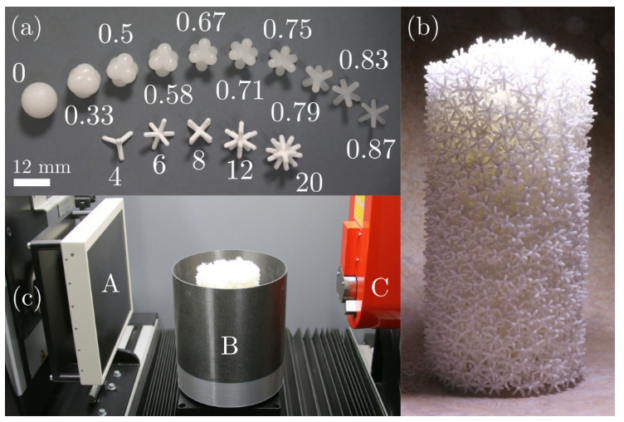
We present a series of experiments investigating the local microstructure of cylindrical piles composed of highly concave particles. By systematically varying particle geometry—from spheres to strongly nonconvex polypods—as well as frictional properties and the number of branches, we explore how these parameters, together with the preparation protocol, shape the internal structure of the system. Using x-ray tomography combined with a dedicated image-analysis pipeline, we accurately extract the position, orientation, and contacts of every particle in each pile. This allows us to quantify the evolution of key structural observables as a function of particle geometry and preparation method. In particular, we measure the distributions of local packing fraction, coordination number, number of neighbors, and contact locations, along with particle-particle positional and orientational correlations. More importantly, we construct a new stability indicator that correlates perfectly with the observed pile stabilities, enabling us to identify the fundamental mechanisms responsible for geometrically induced cohesion in granular systems composed of noninterlocking particle shapes: interdigitation, rotational constraint, friction-mediated cohesion, and the ability of a pile to restabilize.

Macro–micro mechanical behavior of fresh and degraded ballast from triaxial testing and 3D-DEM with clustering-based polyhedral grain reconstruction

 J. Prommarin, P. Jitsangiam, T. Somsri, M. Renouf, E. Azéma, Macro–micro mechanical behavior of fresh and degraded ballast from triaxial testing and 3D-DEM with clustering-based polyhedral grain reconstruction, Computer and Géotechnics 195, 108080 (2026)

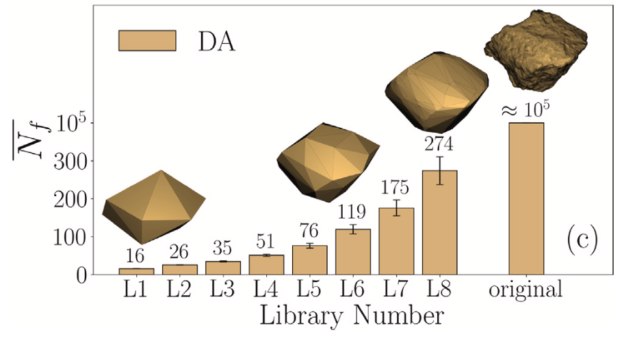
This study investigates the three-dimensional mechanical behavior of fresh and degraded ballast grains from two lithologies (limestone and andesite) by combining advanced laboratory testing and discrete element modeling (DEM). Artificial degradation is induced through multi-million-cycle triaxial loading, after which over 772 grains per lithology and degradation state are digitized using high-resolution 3D point-cloud scanning. A clustering-based reconstruction procedure, inspired by K-means algorithms, is developed to generate polyhedral representations of the grains, characterized by their number of faces and diverse morphological descriptors (i.e., angularity, sphericity…). These digitalized polyhedra are implemented within a Contact Dynamics DEM framework to simulate triaxial compression tests on ballast assemblies. A parametric analysis is performed by varying the number of faces used in the polyhedral reconstruction; macroscopic shear strength responses converge when the number of faces reaches approximately 110–120 faces, indicating that this level of geometric fidelity is sufficient to capture bulk behavior. At the macroscopic scale, all equivalent numerical ballast types exhibit similar residual friction angles of about ≃ 32 − 33◦. In contrast, microscale analysis indicates that fresh andesite develops slightly higher frictional anisotropy than both degraded andesite and fresh limestone. Conversely, fresh limestone and degraded andesite display higher geometric anisotropy than fresh andesite. The balance between frictional and geometric anisotropies explains the similar residual shear strength of fresh and degraded ballast. These results provide a robust framework for linking ballast morphology to performance, with direct implications for the stability and maintenance of ballasted railway tracks.

Comparing granular and fragmentation-driven silo DEM models for block caving

M. Cárdenas-Barrantes, M. Renouf, E. Azéma, C. Ovalle, Powder Technology 476, 122409 (2026)

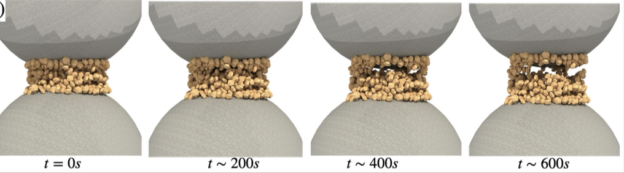
Silo analogies are commonly used in block caving research to study gravity-driven flow and stress redistri- bution. However, most existing models rely on idealized granular assemblies composed of random granular packings, which might differ from fragmented rock masses. The aim of this numerical study is to investigate the influence of material characteristics on flow dynamics and internal stresses in a silo. Using the Discrete Element Method (DEM), we compare three silo models: (i) a caving-like (CL) configuration, generated by progressively de-bonding a tessellated solid column during draw, thus emulating rock fragmentation; (ii) a caving-polygons (CP) configuration, in which the same fragments are deposited randomly into the silo; and (iii) a caving-disks (CD) configuration, representing a traditional granular silo composed of circular particles; all three models share the same particle size distribution. These configurations enable comparing the effects of granular packing, particle shape, interlocking, and fragmentation mechanisms on discharge behavior. Results show that flow velocities, displacement fields, and internal pressure distributions differ markedly between traditional granular silos and fragmentation-driven systems. The CD configuration develops the highest pressures surrounding the outlet, whereas the CL configuration redistributes stresses more efficiently, with forces preferentially supported by the silo walls; the CP system exhibits intermediate behavior. The findings highlight key limitations of conventional silo analogs and underscore the need for more representative material descriptions in block caving simulations. This work provides a basis for selecting appropriate DEM modeling strategies, with perspectives of improving DEM cave-flow predictions.

Jigsaw-fit blocks: A tale of segregation and disaggregation

M. Cabrera, S. Caro, N. Pardo, E. Azéma, M. Roverato, R. Sulpizio, F. Lucchi, Jigsaw-fit blocks: A tale of segregation and disaggregation, Engineering Geology 365, 108630 (2026)

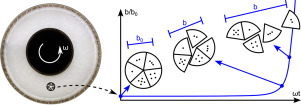
Jigsaw-fit blocks are highly fractured rocks of up to tens of meters wide, associated to volcanic debris avalanches and debris flows, traveling long distances (km) from the volcano edifice. Despite the mass movement long runout and agitated motion, jigsaw-fit blocks are found on their deposits with no apparent disaggregation and with occasional thin matrix facies filling the jigsaw cracks. The mechanisms behind the fragments constrained disaggregation and matrix infilling remain unclear and are limited to field observations. The rheology of granular flows suggests that segregation mechanisms should prevail and high fragmentation rates result from internal shearing and intense inter-granular collisions, challenging the theorized kinematics associated to the frustrated disaggregation of jigsaw-fit blocks. We study experimentally for the first time the segregation and disaggregation processes of analogue jigsaw-fit blocks within a granular flow as a function of fragmentation patterns and fragments density. We found that disaggregation appears regardless of the fragmentation pattern and its initiation is conditioned by the fragment density, occurring faster in fragments lighter than the moving granular media. Our results demonstrate that jigsaw-fit blocks remain united for a short period of shearing, but separate as a result of the fragments rotation and eventual particle infilling. We predict that this work sets a starting point for reviewing the interpretation of jigsaw-fit blocks in debris avalanche deposits, allowing the inference of kinematic features from the fragments configuration and its level of disaggregation.

Static liquefaction: The role of grain size polydispersity from a micro-structural perspective

C. Castro-Malaver, M. Cárdenas-Barrantes , D. Cantor, M. Renouf, E. Azéma, C. Ovalle, A. Lizcano, Static liquefaction: The role of grain size polydispersity from a micro-structural perspective, Computer and Géotechnics 193, 107996 (2026)

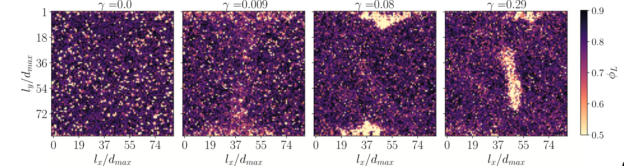
Static liquefaction, defined as the loss of strength after strain softening under undrained shear, is often the cause of catastrophic failures in loose earthfills, waste dumps and tailings storage facilities. The number of failures does not cease to increase yearly, revealing operational faults, construction defects, and a lack of knowledge regarding liquefaction triggering. While liquefaction is well understood at the scale of a representative elementary volume of soil, the triggering mechanisms at the particle scale are seldom studied. This study aims to analyze the links between the micro- and macro-mechanisms controlling static liquefaction by means of numerical simulations using the Discrete Element Method. We consider mono to highly size polydisperse 2D samples of discs, prepared at varied densities from loose to dense packings. As expected, loose samples liquefy, while dense ones continue to exhibit resistance under undrained shearing. Some medium-dense cases liquefy only temporarily, recovering their shear strength at larger strains. We reveal a dual mechanism for liquefaction through multi-scale analysis: a collapse of the contact network—marked by the coordination number dropping below 3—and the emergence of low-density regions. Temporary liquefaction involves transient connectivity loss with minor density fluctuations, enabling stress recovery. In contrast, full liquefaction combines both effects, leading to an irreversibly disconnected and heterogeneous microstructure.

Granular flow down an inclined plane with highly nonconvex particles: Macroscopic behavior, microstructure, and nonlocal rheology

W. Wang, J. Barés, M.Renouf, E. Azéma, Granular flow down an inclined plane with highly nonconvex particles: Macroscopic behavior, microstructure, and nonlocal rheology, Phys. Rev. E, 112, 055410 (2025)

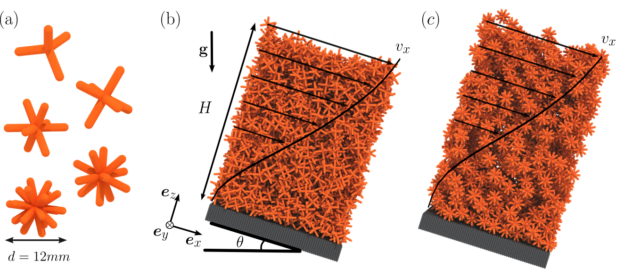
We investigate the flow behavior of highly nonconvex particles on an inclined plane using three-dimensional Contact Dynamics simulations. These particles, termed Platonic polypods, are generated by extruding arms from the faces of Platonic solids, with the number of arms 𝑛𝑏 taking values in {4,6,8,12,20}. Assemblies of these polypods adhere to established flow initiation laws. Interestingly, the onset angle initially decreases with increasing 𝑛𝑏 before slightly rising for larger values. Conversely, the maximum angle marking the transition from dense to collisional flow exhibits the opposite trend. As a result, the angular range supporting dense flow widens with increasing 𝑛𝑏. In the steady dense flow regime, we analyze the stress, packing fraction, velocity, and connectivity profiles of the assemblies. Away from the boundaries, the granular material exhibits uniform packing fraction, inertial number, and coordination number within the bulk. In this region, the flow follows the classical 𝜇⁡(𝐼) rheology. However, near the walls, a “dead zone” emerges, characterized by a localized increase in packing fraction and a sharp reduction in grain velocity. This results in a concave velocity profile over several grain diameters, leading to a breakdown of the 𝜇⁡(𝐼) law. A detailed microstructural analysis reveals enhanced interlocking between particles near the walls compared to the bulk. To reconcile the differences between the flowing region and the dead zone, we adapt a recently proposed nonlocal approach, originally developed for rotating drum flows [Wang  et al., Phys. Rev. Res. 6, 043310 (2024)], to the inclined plane geometry. This approach relies on a fluidity-based description governed by the local packing fraction. The resulting model, consistent with Bagnold scaling, successfully reproduces the full velocity profiles without requiring any fitting parameters.

Particle Scale Anisotropy Controls Bulk Properties in Sheared Granular Materials

C. Lee, E. Bililign, E. Azéma, K. Daniels, Particle Scale Anisotropy Controls Bulk Properties in Sheared Granular Materials, Phys. Rev. Letters, 135, 108201(2025).

The bulk dynamics of dense granular materials arise through a combination of particle-scale and mesoscale effects. Theoretical and numerical studies have shown that collective effects are created by particle-scale anisotropic structures such as grain connectivity, force transmission, and frictional mobilization, all of which influence bulk properties like bulk friction and the stress tensor through the stress-force-fabric (SFF) relationship. To date, establishing the relevance of these effects to laboratory systems has remained elusive due to the challenge of measuring both normal and frictional contact forces at the particle scale. In this study, we perform experiments on a sheared photoelastic granular system in a quasi-2D annular cell. During these experiments, we measure particle locations, contacts, and normal and frictional forces vectors during loading. We reconstruct the angular distributions of the contact and force vectors, and extract the corresponding emergent anisotropies for each of these metrics. Finally, we show for the first time in an experimental system that the SFF relation quantitatively predicts the relationship between particle scale anisotropies, the stress tensor components, and the bulk friction coefficient, capturing even transient behaviors—closing the gap between experimental measurements and prior theoretical and numerical models.