Archives de catégorie : Articles

Inertial shear flow of assemblies of frictionless polygons: Rheology and microstructure

Emilien Azéma, Farhang Radjaï and Jean-Noël Roux, Eur. Phys. J. E (2018) 41: 2
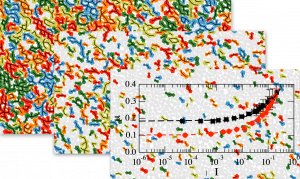
Clusters of particles at I = 4.10−5 (a), I = 10−3 (b), I = 10−2 (c) and I = 0.25 (d) Disjoint clusters are represented in different colors (green, orange, purple and cardinal red). The Inset shows the evolution of macroscopic friction with I.

Motivated by the understanding of shape effects ingranular materials, we numerically investigate the macroscopic and microstructural properties of anisotropic dense assemblies of frictionless polydisperse rigid pentagons in shear flow, and compare them with similar systems of disks. Once subjected to large cumulative shear strains their rheology and microstructure are investigated in uniform steady states, de- pending on inertial number I, which ranges from the quasistatic limit (I ∼ 10−5) to 0.2. In the quasistatic limit both systems are devoid of Reynolds dilatancy, i.e., flow at their random close packing density. Both macroscopic friction angle φ, an increasing function of I, and solid fraction ν, a decreasing function of I, are larger with pentagons than with disks at small I, but the differences decline for larger I and, remark- ably, nearly vanish for I ∼ 0.2. Under growing I, the depletion of contact networks is considerably slower with pentagons, in which increasingly anisotropic, but still well-connected force-transmitting structures are maintained throughout the studied range. Whereas contact anisotropy and force anisotropy contribute nearly equally to the shear strength in disk assemblies, the latter effect dominates with pentagons at small I, while the former takes over for I of the order of 10−2. The size of clusters of grains in side-to-side contact, typically comprising more than 10 pentagons in the quasistatic limit, very gradually decreases for growing I.
Three-dimensional bonded-cell model for grain fragmentation

D. Cantor, E. Azéma, P. Sornay and  F. Radjai, Comp. Part. Mech.
DOI 10.1007/s40571-016-0129-0

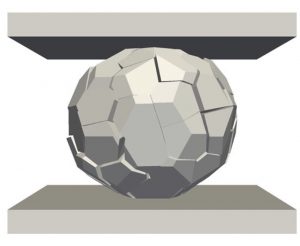
Snapshots of a particle composed of 75 cells undergoing incip- ient breakage under the action of a vertical force

We present a three-dimensional numerical method for the simulation of particle crushing in 3D. This model is capable of producing irregular angular fragments upon par- ticle fragmentation while conserving the total volume. The particle is modeled as a cluster of rigid polyhedral cells gen- erated by a Voronoi tessellation. The cells are bonded along their faces by a cohesive Tresca law with independent tensile and shear strengths and simulated by the contact dynam- ics method. Using this model, we analyze the mechanical response of a single particle subjected to diametral compres- sion for varying number of cells, their degree of disorder, and intercell tensile and shear strength. In particular, we iden- tify the functional dependence of particle strength on the intercell strengths. We find that two different regimes can be distinguished depending on whether intercell shear strength is below or above its tensile strength. In both regimes, we observe a power-law dependence of particle strength on both intercell strengths but with different exponents. The strong effect of intercell shear strength on the particle strength reflects an interlocking effect between cells. In fact, even at low tensile strength, the particle global strength can still considerably increase with intercell shear strength. We finally show that the Weibull statistics describes well the particle strength variability.

Shear strength and microstructure of polydisperse packings: The effect of size span and shape of particle size distribution

Emilien Azéma, Sandra Linéro, Nicolas Estrada and Arcesio Lizcano, Phys. Rev E, 96 022902 2017

Snapshots at the end of the isotropic compression for different combinations of size span and shape of particle size distribution

By means of extensive contact dynamics simulations, we analyzed the effect of particle size distribution (PSD) on the strength and microstructure of sheared granular materials composed of frictional disks. The PSDs are built by means of a normalized β function, which allows the systematic investigation of the effects of both, the size span (from almost monodisperse to highly polydisperse) and the shape of the PSD (from linear to pronouncedly curved). We show that the shear strength is independent of the size span, which substantiates previous results obtained for uniform distributions by packing fraction. Notably, the shear strength is also independent of the shape of the PSD, as shown previously for systems composed of frictionless disks. In contrast, the packing fraction increases with the size span, but decreases with more pronounced PSD curvature. At the microscale, we analyzed the connectivity and anisotropies of the contacts and forces networks. We show that the invariance of the shear strength with the PSD is due to a compensation mechanism which involves both geometrical sources of anisotropy. In particular, contact orientation anisotropy decreases with the size span and increases with PSD curvature, while the branch length anisotropy behaves inversely.

Binary mixtures of disks and elongated particles: Texture and mechanical properties

Emilien Azéma,  Itthichai Preechawuttipong,  and Farhang Radjai, PHYSICAL REVIEW E 94, 042901 (2016)

Snapshots of force-bearing particles in a segregated packing

We analyze the shear strength and microstructure of binary granular mixtures consisting of disks and elongated particles by varying systematically both the mixture ratio and degree of homogeneity (from homogeneous to fully segregated). The contact dynamics method is used for numerical simulations with rigid particles interacting by frictional contacts. A counterintuitive finding of this work is that the shear strength, packing fraction, and, at the microscopic scale, the fabric, force, and friction anisotropies of the contact network are all nearly independent of the degree of homogeneity. In other words, homogeneous mixtures have the same strength properties as segregated packings of the two particle shapes. In contrast, the shear strength increases with the proportion of elongated particles correlatively with the increase of the corresponding force and fabric anisotropies. By a detailed analysis of the contact network topology, we show that various contact types contribute differently to force transmission and friction mobilization.

Scaling behaviour of cohesive granular flows

Nicolas Berger, Emilien Azéma, Jean-François Douce and Farhang Radjai EPL 112 (2015) 6004

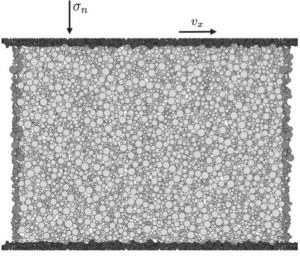
Plane shear simulation. Black particles compose the rough walls. The periodic left-right boundaries are marked by gray particles.

The shear strength of dense granular flows is generally described by an effective friction coefficient, ratio of shear to normal stress, as a function of the inertial number I. However, this ratio depends on the normal stress when the particles interact via both friction and adhesion forces, and in this sense it does not properly represent a Coulomb-like friction. For the same reason, it is not a unique function of I. We used extensive contact dynamics simulations to isolate the cohesive strength from the purely frictional strength in dense inertial flows for a broad range of shear rates and adhesion forces between particles. Remarkably, while the frictional part of the strength increases with I, the cohesive strength is found to be a decreasing function of I. We show that a single dimensionless parameter, combining interparticle adhesion with I, controls not only the cohesive strength but also the packing fraction and granular text

Effects of shape and size polydispersity on strength properties of granular materials

Duc-Hanh Nguyen, Emilien Azéma, Philippe Sornay,  and Farhang Radjai, PHYSICAL REVIEW E 91, 032203 (2015)

Snapshots of force-bearing particles in polydisperse packing

By means of extensive contact dynamics simulations, we analyze the combined effects of polydispersity both in particle size and in particle shape, defined as the degree of shape irregularity, on the shear strength and microstructure of sheared granular materials composed of pentagonal particles. We find that the shear strength is independent of the size span, but unexpectedly, it declines with increasing shape polydispersity. At the same time, the solid fraction is an increasing function of both the size span and the shape polydispersity. Hence, the densest and loosest packings have the same shear strength. At the scale of the particles and their contacts, we analyze the connectivity of particles, force transmission, and friction mobilization as well as their anisotropies. We show that stronger forces are carried by larger particles and propped by an increasing number of small particles. The independence of shear strength with regard to size span is shown to be a consequence of contact network self-organization, with the falloff of contact anisotropy compensated by increasing force anisotropy.

Split-Cell Method for grain fragmentation

David Cantor,  Nicolas Estrada, Emilien Azéma, Computers and Geotechnics 67 (2015) 150–156

This article presents a model of grain fragmentation to be implemented in discrete element methods: the Split-Cell Method (SCM). In this method, the particles are of polygonal shape, and they split into polygo- nal cells once a certain failure criterion, depending on the forces exerted at the contacts, the size and shape of the grain, and the tensile strength of the material, is satisfied. The SCM is an improvement compared to other methods currently available in the literature, given that it does not restrict the shape of the grains or their fragments, mass is conserved throughout the fragmentation events, and it does not introduce artificial length scales in the system. In order to validate the proposed method, an experiment using plaster particles was conducted and its results were compared to those of a numerical simulation of the same system, finding a good match between both the experiment and the simulation.

Bonded-cell model for particle fracture

Duc-Hanh Nguyen,  Emilien Azéma,  Philippe Sornay,  and Farhang Radjai, PHYSICAL REVIEW E 91, 022203 (2015)

A single circular particle subjected to diametral compression (Brazilian test)

Particle degradation and fracture play an important role in natural granular flows and in many applications of granular materials. We analyze the fracture properties of two-dimensional disklike particles modeled as aggregates of rigid cells bonded along their sides by a cohesive Mohr-Coulomb law and simulated by the contact dynamics method. We show that the compressive strength scales with tensile strength between cells but depends also on the friction coefficient and a parameter describing cell shape distribution. The statistical scatter of compressive strength is well described by the Weibull distribution function with a shape parameter varying from 6 to 10 depending on cell shape distribution. We show that this distribution may be understood in terms of percolating critical intercellular contacts. We propose a random-walk model of critical contacts that leads to particle size dependence of the compressive strength in good agreement with our simulation data.

Internal friction and absence of dilatancy of packings of frictionless polygons

Emilien Azéma, Farhang Radjaï and Jean-Noël Roux, PHYSICAL REVIEW E 91, 010202(R) (2015)

By means of numerical simulations, we show that assemblies of frictionless rigid pentagons in slow shear flow possess an internal friction coefficient (equal to 0.183 ± 0.008 with our choice of moderately polydisperse grains) but no macroscopic dilatancy. In other words, despite side-side contacts tending to hinder relative particle rotations, the solid fraction under quasistatic shear coincides with that of isotropic random close packings of pentagonal particles. Properties of polygonal grains are thus similar to those of disks in that respect. We argue that continuous reshuffling of the force-bearing network leads to frequent collapsing events at the microscale, thereby causing the macroscopic dilatancy to vanish. Despite such rearrangements, the shear flow favors an anisotropic structure that is at the origin of the ability of the system to sustain shear stress.

Particle alignment and clustering in sheared granular materials composed of platy particles

Mauricio Boton, Nicolas Estrada, Emilien Azéma and Farhang Radjai, Eur. Phys. J. E (2014) 37: 11.

By means of molecular dynamics simulations, we investigate the texture and local ordering in sheared packings composed of cohesionless platy particles. The morphology of large packings of platy particles in quasistatic equilibrium is complex due to the combined effects of local nematic ordering of the particles and anisotropic orientations of contacts between particles. We find that particle alignment is strongly enhanced by the degree of platyness and leads to the formation of face-connected clusters of expo- nentially decaying size. Interestingly, due to dynamics in continuous shearing, this ordering phenomenon emerges even in systems composed of particles of very low platyness differing only slightly from spheri- cal shape. The number of clusters is an increasing function of platyness. However, at high platyness the proportion of face-face interactions is too low to allow for their percolation throughout the system.