Archives de catégorie : Articles

Dense granular dynamics analysis by a domain decomposition approach

V. Visseq, A. Martin, D. Iceta,  E. Azema, D. Dureisseix · P. Alart, Computational Mechanics (2012), doi : 10.1007/s00466-012-0699-5.

In this article a domain decomposition approach is combined with the NonSmooth Contact Dynamics approach for analysing the global behaviour and the mi- cromechanical structure of large-scale dense granular systems. Previously introduced and theoretically investigated, this method is herein investigated precisely on two aspects: the properties of the interface operators, especially when applied to the corners of the subdomains, and the influence of the substructuring on the solution of a mechanical test. Such topics are specific to the dense granular systems char- acterized by the discreteness and the nonsmoothness of their behavior.
Identification of rolling resistance as a shape parameter in sheared granular media

Nicolas Estrada,  Emilien Azéma, Farhang Radjai and Alfredo Taboada PHYSICAL REVIEW E 84, 011306 (2011)

Using contact dynamics simulations, we compare the effect of rolling resistance at the contacts in granular systems composed of disks with the effect of angularity in granular systems composed of regular polygonal particles. In simple shear conditions, we consider four aspects of the mechanical behavior of these systems in the steady state: shear strength, solid fraction, force and fabric anisotropies, and probability distribution of contact forces. Our main finding is that, based on the energy dissipation associated with relative rotation between two particles in contact, the effect of rolling resistance can explicitly be identified with that of the number of sides in a regular polygonal particle. This finding supports the use of rolling resistance as a shape parameter accounting for particle angularity and shows unambiguously that one of the main influencing factors behind the mechanical behavior of granular systems composed of noncircular particles is the partial hindrance of rotations as a result of angular particle shape.

Stress-strain behavior and geometrical properties of packings of elongated particles

Emilien Azéma and Farhang Radjai, PHYSICAL REVIEW E 81, 051304 2010

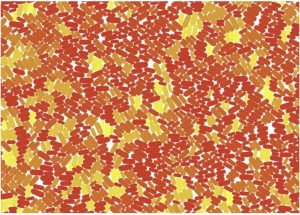
Color level map of particle orientations

We present a numerical analysis of the effect of particle elongation on the quasistatic behavior of sheared granular media by means of the contact dynamics method. The particle shapes are rounded-cap rectangles characterized by their elongation. The macroscopic and microstructural properties of several packings sub- jected to biaxial compression are analyzed as a function of particle elongation. We find that the shear strength is an increasing linear function of elongation. Performing an additive decomposition of the stress tensor based on a harmonic approximation of the angular dependence of branch vectors, contact normals, and forces, we show that the increasing mobilization of friction force and the associated anisotropy are key effects of particle elongation. These effects are correlated with partial nematic ordering of the particles which tend to be oriented perpendicular to the major principal stress direction and form side-to-side contacts. However, the force trans- mission is found to be mainly guided by cap-to-side contacts, which represent the largest fraction of contacts for the most elongated particles. Another interesting finding is that, in contrast to shear strength, the solid fraction first increases with particle elongation but declines as the particles become more elongated. It is also remarkable that the coordination number does not follow this trend so that the packings of more elongated particles are looser but more strongly connected.

Shear strength of granular materials

Farhang Radjai and Emilien Azéma, European Journal of Civil Engineering, Volume 13, N02/2009, 203-218.

The shear strength properties of granular materials reflect their inherent force and fabric anisotropy. We analyze the role of fabric and force anisotropies with respect to the critical-state shear strength. Then, a model of accessible geometrical states in terms of particle connectivity and contact anisotropy is presented. This model incorporates in a simple way the fact that, due to steric exclusions, the highest levels of connectivity and anisotropy cannot be reached simultaneously, a property that affects seriously the shear strength. We also analyze the force anisotropy in the light of the specific role of weak forces in sustaining strong force chains and thus the main mechanism that underlies anisotropic force patterns. Finally, we briefly discuss the effect of interparticle friction, particle shape, and adhesion.

Quasistatic rheology, force transmission and fabric properties of a packing of irregular polyhedral particles

E. Azéma, F. Radjai, G. Saussine, Mechanics of Materials 41 (2009) 729–741

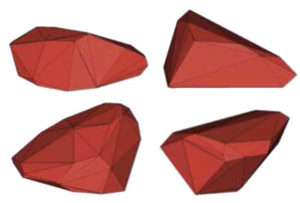
Examples of polyhedra used in the simulations

By means of contact dynamics simulations, we investigate a dense packing composed of irregular polyhedral particles under quasistatic shearing. The effect of particle shape is ana- lyzed by comparing the polyhedra packing with a packing of similar particle size distribu- tion but with spherical particles. The polyhedra packing shows higher shear stress and dilatancy but similar stress–dilatancy relation compared to the sphere packing. A harmonic approximation of granular fabric is presented in terms of branch vectors (connecting par- ticle centers) and contact force components along and perpendicular to the branch vectors. It is found that the origin of enhanced shear strength of the polyhedra packing lies in its higher force anisotropy with respect to the sphere packing which has a higher fabric anisotropy. Various contact types (face–vertex, face–face, etc.) contribute differently to force transmission and fabric anisotropy. In particular, most face–face contacts belong to strong force chains along the major principal stress direction whereas vertex–face contacts are correlated with weak forces and oriented on average along the minor principal stress direction in steady shearing.

Force transmission in dry and wet granular media

Vincent Richefeu, Moulay Saïd El Youssoufi, Emilien Azéma, Farhang Radjaï, Powder Technology 190 (2009) 258–263

We compare the probability density functions of normal forces in dry and wet granular systems from 3D simulations by molecular dynamics and contact dynamics methods. While the strong forces are characterized by a decreasing exponential distribution, we show that in the range of weak forces the force distribution in a dry granular packing is sensitive to the anisotropy of the packing and the shape of the particles. By means of a model of capillary cohesion, implemented as a force law expressing the capillary force as a function of water volume and the distance between particles, we find that distributions are exponential for both compressive and tensile forces. The particle pressures are shown to form a bi- percolating structure.

Short-time dynamics of a packing of polyhedral grains under horizontal vibrations

E. Azéma, F. Radjaï, R. Peyroux, V. Richefeu and G. Saussine, Eur. Phys. J. E 26, 327–335 (2008

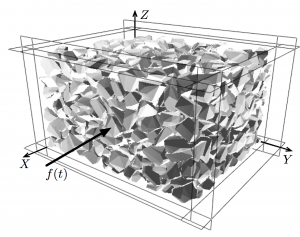
A snapshot of the packing inside a box with a free wall over which the driving force f(t) is applied along the x-direction.

We analyze the dynamics of a 3D granular packing composed of particles of irregular polyhedral shape confined inside a rectangular box with a retaining wall subjected to horizontal harmonic forcing. The simulations are performed by means of the contact dynamics method for a broad set of loading parameters. We explore the vibrational dynamics of the packing, the evolution of solid fraction and the scaling of dy- namics with the loading parameters. We show that the motion of the retaining wall is strongly anharmonic as a result of jamming and grain rearrangements. It is found that the mean particle displacement scales with inverse square of frequency, the inverse of the force amplitude and the square of gravity. The short- time compaction rate grows in proportion to frequency up to a characteristic frequency, corresponding to collective particle rearrangements between equilibrium states, and then it declines in inverse proportion to frequency.


Force transmission in a packing of pentagonal particles

E. Azéma, F. Radjaï, R. Peyroux, G. Saussine, Physical Review E , 76, 011301 (2007).


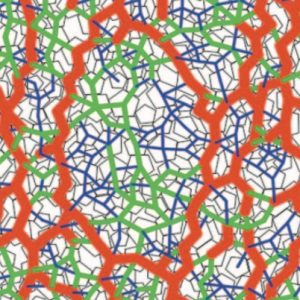
A map of the contact network composed of very weak, intermediate, and strong contacts in the pentagon packing.

We perform a detailed analysis of the contact force network in a dense confined packing of pentagonal particles simulated by means of the contact dynamics method. The effect of particle shape is evidenced by comparing the data from pentagon packing and from a packing with identical characteristics, except for the circular shape of the particles. A counterintuitive finding of this work is that, under steady shearing, the pentagon packing develops a lower structural anisotropy than the disk packing. We show that this weakness is compensated by a higher force anisotropy, leading to enhanced shear strength of the pentagon packing. We revisit “strong” and “weak” force networks in the pentagon packing, but our simulation data also provide evidence for a large class of “very weak” forces carried mainly by vertex-to-edge contacts. The strong force chains are mostly composed of edge-to-edge contacts with a marked zigzag aspect and a decreasing exponen- tial probability distribution as in a disk packing.

Vibrational dynamics of confined granular materials

E. Azéma, F. Radjaï, R. Peyroux, F. Dubois, G. Saussine, Physical Review E, 74, 031302 (2006).

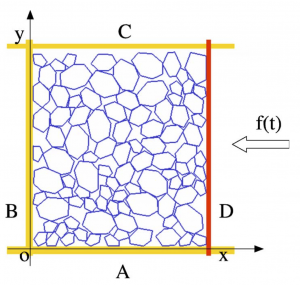
By means of two-dimensional contact dynamics simulations, we analyze the vibrational dynamics of a confined granular layer in response to harmonic forcing. We use irregular

The geometry of the packing.

polygonal grains allowing for strong variability of solid fraction. The system involves a jammed state separating passive loading and active unloading states. We show that an approximate expression of the packing resistance force as a function of the displacement of the free retaining wall from the jamming position provides a good description of the dynamics. We study in detail the scaling of displacements and velocities with loading parameters. In particular, we find that, for a wide range of frequencies, the data collapse by scaling the displacements with the inverse square of frequency, the inverse of the force amplitude, and the square of gravity. Interestingly, compaction occurs during the extension of the packing, followed by decompaction in the contraction phase. We show that the mean compaction rate increases linearly with frequency up to a characteristic frequency and then it declines in inverse proportion to frequency. The characteristic frequency is interpreted in terms of the time required for the relaxation of the packing through collective grain rearrangements between two equilibrium states.