M. Cardenas-Barrantes, D. Cantor, J. Barés, M. Renouf and E. Azéma, Compaction of mixtures of rigid and highly deformable particles: A micromechanical model , Phys. Rev. E, 102, 032904 (2020). https://journals.aps.org/pre/abstract/10.1103/PhysRevE.102.032904
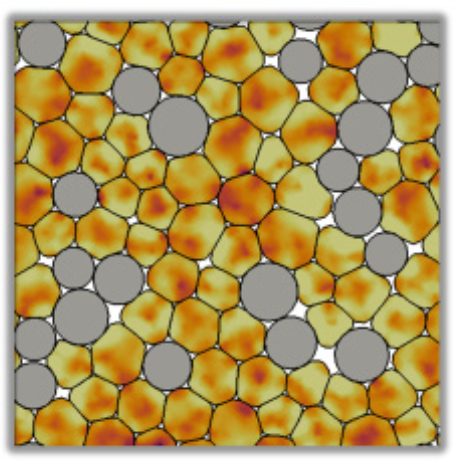
We analyze the isotropic compaction of mixtures composed of rigid and deformable incompressible particles by the nonsmooth contact dynamics approach. The deformable bodies are simulated using a hyperelastic neo-Hookean constitutive law by means of classical finite elements. We characterize the evolution of the packing fraction, the elastic modulus, and the connectivity as a function of the applied stresses when varying the interparticle coefficient of friction. We show first that the packing fraction increases and tends asymptotically to a maximum value φmax , which depends on both the mixture ratio and the interparticle friction. The bulk modulus is also shown to increase with the packing fraction and to diverge as it approaches φmax . From the micromechanical expression of the granular stress tensor, we develop a model to describe the compaction behavior as a function of the applied pressure, the Young modulus of the deformable particles, and the mixture ratio. A bulk equation is also derived from the compaction equation. This model lays on the characterization of a single deformable particle under compression together with a power-law relation between connectivity and packing fraction. This compaction model, set by well-defined physical quantities, results in outstanding predictions from the jamming point up to very high densities and allows us to give a direct prediction of φmax as a function of both the mixture ratio and the friction coefficient.